Aging doesn’t really start where most people notice it. By the time changes show up in the skin or energy levels, the underlying shifts have usually been happening for a while.
At a biological level, aging is tied to how well the body maintains itself, how efficiently it repairs damage, produces essential proteins, and keeps different systems in sync. Over time, those processes don’t stop, but they do slow down. Communication between cells becomes less consistent, and that’s often where the first real decline begins.
That’s part of the reason treatments have started moving away from surface-level fixes.
Peptide therapy is one of those approaches that focuses more on what’s happening internally. Instead of trying to correct a single symptom, it works on improving how the body regulates itself. At Better Living MD, this is usually part of a broader plan rather than a standalone treatment.
For people looking into anti-aging treatment in Atlanta, that shift in approach tends to matter. It’s less about quick changes and more about whether the body is functioning the way it should over time.
What are Peptides and How Do They Work in the Human Body?
Peptides are short chains of amino acids, but that definition doesn’t really explain why they matter.
What’s more relevant is what they do. Peptides act as messengers. They help different parts of the body communicate by sending signals that tell cells when to repair tissue, produce collagen, or adjust certain metabolic functions.
As those signals weaken with age, the body doesn’t respond as efficiently. It’s not that the systems disappear, they just don’t get activated in the same way.
Peptide therapy works by supporting those signals.
It doesn’t replace hormones or force a reaction. Instead, it nudges existing pathways so they function more consistently again. That’s why the effects tend to build gradually rather than showing up all at once.
In a clinical setting like Better Living MD, peptides aren’t chosen randomly. They’re usually selected based on what’s actually going on, such as whether the issue is recovery, skin changes, energy levels, or something more systemic.
How Do Peptides Support Anti-Aging at a Biological Level?
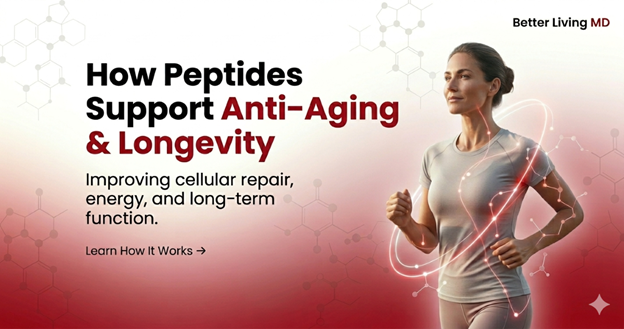
Peptides support anti-aging by improving how the body communicates internally. That may sound simple, but it’s actually where a lot of age-related decline begins.
Over time, cells don’t just get damaged. They also stop “talking” to each other as efficiently. Signals that once triggered repair, collagen production, or energy regulation start to weaken. When that happens, the body slows down in ways that become noticeable, whether it’s in the skin, energy levels, or recovery.
Peptides step in at that communication level.
They don’t replace anything outright. Instead, they help re-activate certain signaling pathways that are already present but less active with age. In practical terms, that can influence how well the body repairs tissue, maintains skin structure, or regulates inflammation.
Some peptides are also associated with supporting mitochondrial activity, which affects how cells produce energy. Others are linked to collagen synthesis or recovery processes. It’s not one single effect. It’s a combination of smaller adjustments that, over time, change how the body functions overall.
That’s part of the reason peptide therapy is being included more often in anti-aging treatment in Atlanta, especially in settings that focus on long-term function rather than quick fixes.
At Better Living MD, this isn’t approached as a standalone solution. Peptides are usually one part of a broader plan that looks at hormone balance, metabolic health, and underlying deficiencies. Without that context, results tend to be limited.
And that’s really the key point. Peptides don’t “reverse aging” in a dramatic way. What they can do is help the body operate more efficiently again, which is often what people are actually looking for.
What Benefits Can Peptide Therapy Offer for Aging and Longevity?
The benefits of peptide therapy aren’t always immediate, and they don’t show up in just one area.
Most of the time, changes are gradual. People might notice their energy improving first, or recovery getting a bit easier. Skin changes can happen too, but they tend to follow rather than lead.
Some of the more commonly reported effects include:
- Improved skin texture and elasticity over time
- Better energy levels and less day-to-day fatigue
- Faster recovery after physical activity
- Support for maintaining muscle tone
- Clearer focus or more stable mental energy
That said, not everyone experiences the same changes in the same way. A lot depends on baseline health, consistency, and whether other underlying issues are being addressed alongside peptide therapy.
At Better Living MD, that broader context is usually part of the process. The goal isn’t to chase isolated improvements, but to make sure different systems are working together more efficiently.
Are Peptide Therapies Safe and How are They Used Clinically?
Peptide therapy is generally considered safe when it’s used under proper medical supervision. But that qualifier matters.
The way peptides are selected, dosed, and monitored makes a significant difference in how well they work and how well they’re tolerated.
At Better Living MD, the process doesn’t start with the treatment itself. It starts with evaluation, which includes looking at symptoms, health history, and often lab work to understand what’s actually contributing to the issue.
From there, therapy is adjusted rather than fixed.
Typically, that includes:
- Identifying underlying imbalances before starting
- Choosing peptides based on specific needs
- Monitoring how the body responds over time
- Adjusting protocols as needed rather than keeping them static
This kind of approach tends to be more effective than standardized plans, especially when the goal is long-term improvement rather than short-term results.
Who is an Ideal Candidate for Peptide-Based Anti-Aging Treatment?
There isn’t a single profile that fits everyone, but certain patterns show up more often.
People usually start considering peptide therapy when they notice changes that don’t resolve easily, such as lower energy, slower recovery, or subtle declines that don’t point to one clear issue.
It’s also common among those who are thinking more proactively about aging.
In general, it may be relevant for individuals who:
- Feel consistently low on energy without a clear cause
- Notice longer recovery times after activity
- Are seeing gradual changes in skin quality
- Want to maintain muscle and metabolic health
- Prefer a more medically guided approach to anti-aging
At Better Living MD, this isn’t determined by age alone. The focus is more on how the body is functioning overall, which tends to give a clearer picture of whether peptide therapy makes sense.
How Do Peptides Compare with Traditional Anti-Aging Treatments?
Most traditional anti-aging treatments are designed to address visible changes. They can be effective for that, but they usually don’t influence what’s happening internally.
Peptides work differently
Instead of focusing on surface-level outcomes, they target the systems that regulate repair and maintenance. That doesn’t mean they replace other treatments, but they serve a different role.
A simple way to look at it:
- Traditional treatments focus on how things look
- Peptides focus on how things function
- Cosmetic approaches tend to be localized
- Peptide therapy works across systems
That distinction is why peptide therapy is often included in more comprehensive anti-aging treatment in Atlanta, especially in clinics that take a functional or regenerative approach.
Where Can You Get Anti-Aging Treatment in Atlanta?
Options for anti-aging treatment in Atlanta have expanded quite a bit, but not all approaches are built the same way.
At Better Living MD, the focus is less on offering a single solution and more on building a plan that fits the individual. Peptide therapy is part of that, but it’s usually combined with other strategies based on what’s actually needed.
That might include looking at hormone balance, metabolic function, or nutritional factors alongside peptide use.
The idea is to address the bigger picture, not just one piece of it.
What Results Can You Expect from Peptide Therapy?
Results from peptide therapy tend to build gradually. That’s usually a good sign. It means the body is adjusting rather than reacting abruptly.
Some people notice small changes early on, like improved sleep or slightly better energy. Other effects take longer, especially when they involve skin or body composition.
Over time, improvements may include:
- More stable energy levels throughout the day
- Better recovery after activity
- Gradual improvements in skin quality
- Increased overall sense of balance or well-being
The exact timeline varies, and consistency tends to play a big role.
Is Peptide Therapy Right for Your Anti-Aging Goals?
Peptide therapy isn’t about quick fixes, and it’s not meant to replace every other approach.
What it offers is a way to support how the body functions over time. For some people, that’s exactly what they’re looking for — something that works in the background rather than creating immediate but temporary changes.
For those exploring anti-aging treatment in Atlanta, it can be a useful option, especially when it’s part of a broader, medically guided plan like the ones used at Better Living MD.
In Conclusion
Aging doesn’t happen all at once, and it usually isn’t caused by a single factor. It’s the result of small changes adding up, such as slower repair, less efficient signaling, and reduced balance across different systems.
Peptides don’t stop that process entirely, but they can help shift how the body responds to it.
By supporting communication at the cellular level, they allow certain functions to operate more efficiently again. Over time, that can make a noticeable difference in energy, recovery, and overall resilience.
At Better Living MD, this approach is used as part of a larger strategy. If you’re looking to understand how these therapies fit into a broader approach to aging, there’s more to explore.
Visit our blog to learn how Better Living MD approaches personalized treatments with a focus on long-term health, balance, and sustainable results.
Frequently Asked Questions
- Which anti-aging treatment works best?
There isn’t a single treatment that works best for everyone. Aging affects multiple systems, including skin, hormones, metabolism, and cellular repair.
At Better Living MD, the focus is on combining therapies based on individual needs. This may include peptide therapy, hormone support, and targeted aesthetic treatments. The goal is to improve how the body functions overall, not just address visible signs.
- How can you improve signs of aging without looking overdone?
Natural-looking results usually come from supporting the body rather than overcorrecting it. Treatments that improve collagen production, cellular repair, and internal balance tend to create more gradual and subtle changes.
This is why many patients choose approaches like peptide therapy as part of a broader plan, instead of relying only on cosmetic procedures.
- How much does anti-aging treatment cost in Atlanta?
The cost of anti-aging treatment in Atlanta varies depending on the type of therapy and level of personalization.
Peptide therapy and functional medicine programs are typically structured as ongoing plans rather than one-time treatments. Pricing depends on factors like lab testing, treatment complexity, and physician oversight.
At Better Living MD, care plans are customized, so costs are discussed after an initial evaluation.
- How much is Botox in Atlanta, GA?
Botox is usually priced per unit, and the total cost depends on the treatment area and number of units required.
While Botox can be effective for reducing wrinkles, it addresses surface-level concerns. Many patients combine it with other therapies to support longer-term skin health and overall aging.
- Are peptides better than Botox for anti-aging?
Peptides and Botox serve different roles. Botox relaxes muscles to reduce wrinkles, while peptides support cellular repair, collagen production, and internal balance.
They are not direct alternatives. In many cases, they can be used together as part of a more comprehensive anti-aging plan.
- How long does peptide therapy take to show results?
Peptide therapy works gradually. Some people notice early changes in energy or recovery within a few weeks, while skin and structural improvements take longer.
Most results develop over time as the body responds to improved cellular signaling and repair processes.